On this page14 sections
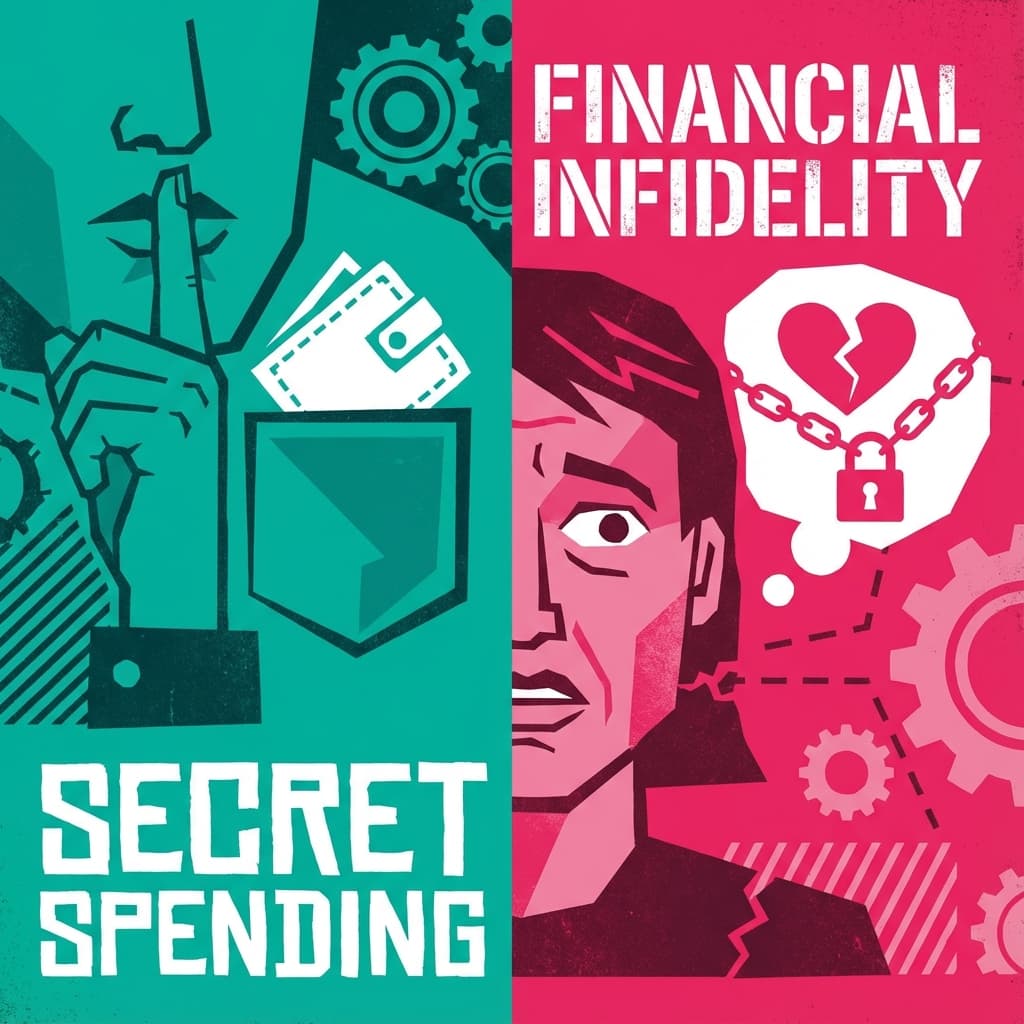
Financial infidelity means deliberately concealing money facts a partner would reasonably expect to know: an account, a debt, an income stream, the real size of a purchase. It is a useful term. What it does not have is a credible measurement.
If you have just searched this because of something you found, three things matter, in this order. First, whether what you are looking at is deception or someone protecting themselves — those need opposite responses. Second, what you are actually exposed to financially, which depends on your accounts and your country, not on how bad the betrayal feels. Third, how to raise it. The prevalence statistics matter least of all, and they are the part of this topic most likely to be wrong.
The honest state of the evidence
Almost everything published about how common financial infidelity is comes from surveys commissioned by companies that sell financial products. That does not make the findings false. It does mean they are marketing artefacts first and measurements second, and most of them do not publish the things you would need to judge them: how many people were asked, when, how they were sampled, and the exact wording of the question.
Here are the three figures we were able to verify on a publisher's own page, with what is known and not known about each.
Three verifiable numbers — and what is missing from each
All are self-reported survey answers, not measured behaviour
Source: YouGov, Most Brits' couples have their own money set aside, May 2019; Legal & General, Opinium poll of 3,000 UK adults in relationships, August 2025
Read that caption again, because it is the whole problem with this topic's statistics. YouGov asked about secret savings, which is close to concealment. Legal & General asked about not combining finances, which is a structural choice most unmarried couples make deliberately. Headline writers merge the two, and a 26% "not sharing" figure becomes a 26% "hiding" figure by the third retelling.
So when you see a headline of the form "40% of couples commit financial infidelity", ask three questions: who paid for the survey, how many people were asked, and what exactly were they asked. If the page cannot answer all three, the number tells you nothing. We could not find a figure that answers all three, which is why this article does not lead with one.
What is better established is that money is a common source of relationship strain — though the best UK evidence on that is also getting old.
What UK adults named as a strain on their relationships
Relate's 'The Way We Are Now' study — fieldwork was June–July 2016, so treat it as dated
Source: Relate, Relationships Scotland and Marriage Care, YouGov survey of over 5,000 UK adults, fieldwork 18 June – 7 July 2016, published March 2017
Where the line actually sits
Privacy is not secrecy. A partner who has their own current account, their own spending money and a birthday present you are not allowed to see is not deceiving you. The test is not whether information is shared but whether it is hidden from a decision you are jointly making. Two people running separate accounts with an agreed split can be completely transparent. Two people with one joint account can be completely opaque if only one of them ever opens the statement.
That second case is more common than the dramatic version. In the UK, the Financial Conduct Authority's Financial Lives 2024 survey found that among adults with low financial capability, a third said they must rely on their partner or another family member to deal with financial matters for them — against 7% of adults without low financial capability. That base is narrow — 1,863 adults with low financial capability, not adults in general — so it is not a figure about all couples. But it describes a real structure: one person holds all the information, and the other could not detect concealment even if they wanted to.
Concealment is easiest where one person has delegated. That is why the fix later in this article is structural rather than moral.
Before anything else: is this deception, or is it safety?
This is the branch the standard advice skips, and getting it wrong is dangerous.
Hiding money can be self-protection. If one partner controls the household's money — who has cards, who sees statements, whether the other can earn or spend — then a secret account is not a betrayal, it is an exit route. In that situation the usual guidance to gather evidence quietly and then confront is exactly wrong: a confrontation that reveals a hidden account can remove someone's only means of leaving.
Surviving Economic Abuse commissioned Ipsos to survey 2,849 UK women, with fieldwork running from 25 October to 1 November 2024. Of those, 437 reported economic abuse by a current or former partner in the previous 12 months — one in seven, which the charity grosses up to around 4.1 million women. Ipsos gives the prevalence as 15%. In the same poll, nearly a quarter of those who reported abuse said it had stopped them leaving, which the charity translates to roughly 940,000 women. That is a charity-commissioned survey, but it was run by a professional pollster with a published sample and fieldwork window, which puts it a long way above the PR polls above.
Ask yourself which description fits:
- Deception: one person is concealing spending, debt or income from shared decisions, and both people otherwise have equal access to money and information.
- Control: one person restricts the other's access to money, work, accounts or information; the "secrecy" runs from the person with less power to the person with more.
If it is control — or if you are unsure, or if raising money makes you frightened rather than angry — stop reading budgeting advice and talk to someone who does this professionally. In the UK, Surviving Economic Abuse specialises in exactly this, and the National Domestic Abuse Helpline run by Refuge is free and open around the clock on 0808 2000 247. In the US, the National Domestic Violence Hotline is on 1-800-799-7233. Nothing else in this article applies until that question is answered.
What you are actually exposed to
This is the practical reason people search this term at 2am, and it is the part most articles omit. Your exposure depends on the accounts, not the emotions.
Joint accounts create joint and several liability. Either of you can withdraw the whole balance without the other's consent, and both of you are liable for the entire overdraft, not half of it. That is true regardless of who spent the money.
Credit files work differently in each market, and this is where most advice goes wrong. "A credit score dropping unexpectedly" is regularly listed as a warning sign of a partner's hidden borrowing. In the US that is generally not true: credit files are individual, and a partner's own card or loan does not appear on your report unless you are a joint account holder, a co-signer or an authorised user. In the UK, taking joint credit creates a financial association, and once that link exists a lender searching your file can see the linked person's data. If you have separated, closing the joint product is not enough — you have to ask each credit reference agency to break the association as well, which is covered in our guide to repairing a UK credit file.
Invisible debt is real even where files are separate. The US Consumer Financial Protection Bureau matched credit records in June 2024 and found that 13.2% of consumers who share credit with a household member had a student loan on their own report — but 21.8% were exposed to one once their partner's record was counted too. That is administrative credit data, not a survey. The CFPB also notes that in many US states both spouses can be legally responsible for certain debts held in one name, so "it's in their name" is not a reliable shield. The same report found about 52% of consumers with a mortgage share it with a linked household member, which is where the largest joint exposure usually sits.
Hidden borrowing outlives the argument about it.
How long a defaulted debt stays visible on a credit file
- USUnited States7 yearsmost negative information; up to 10 years for a bankruptcyFair Credit Reporting Act limits, as restated by the regulator.Consumer Financial Protection Bureau (Ask CFPB)
- UKUnited Kingdom6 yearsfrom the date of default, whether or not the debt is ever clearedSame six-year period applies to CCJs, missed payments, bankruptcy orders and IVAs.National Debtline (Money Advice Trust)
Pull your own file first, before any conversation. It is free in both priority markets, and worth doing even if you find nothing: the FCA's credit information findings from Financial Lives 2024 report that only 34% of UK adults obtained a credit report or checked their score in the year to May 2024 (base 3,392 adults, drawn from a random probability survey of 17,950), and one in ten of those who checked found an error, with 30% of those still unresolved.
The conversation
Scripts feel artificial, which is the point — you want a structure that survives the moment your voice goes.
A disclosure conversation that does not escalate
Editorial structure, not research findings. Step 0 is not optional.
- 0. Answer the safety question firstIf money is being used to control you, do not gather evidence and confront. Speak to a domestic abuse or economic abuse service before you change anything about your accounts. The rest of this sequence assumes both people have equal access to money and information.
- 1. Get the facts before the feelingsYour own credit report, current balances, and the specific documents you found. You are establishing scope, not building a case. Do not access accounts you are not named on.
- 2. Name the time, not the topic'Can we sit down at eight, I found something about the credit card and I want to understand it.' Ambushes produce defensiveness, and 'we need to talk' produces six hours of dread.
- 3. Open with the fact and the feeling, in that order'There is a card I did not know about with a balance on it. I am not angry about the money, I am shaken that I did not know.' One sentence, then stop talking.
- 4. Ask the scope question once, and write down the answer'Is there anything else — any other account, card, loan or income?' The single worst outcome is a second discovery in three weeks, which turns one breach of trust into a pattern.
- 5. Agree the next step, not the verdictThe only decision tonight is what happens in the next seven days: full statements from both of you, or a session booked with a counsellor or debt adviser. Everything else waits.
- 6. Plan for it going badlyIf it turns into denial, blame-shifting or rage, end the conversation rather than winning it. 'I am not doing this tonight' is a complete sentence. If addiction or coercion is in play, involve a professional before the second attempt.
If you were the one concealing, the sequencing matters more than the apology. Partial disclosure that is later topped up is experienced as a second lie. Give the whole number the first time, including the bit that makes you look worst.
What recovery actually looks like over time
Total transparency is a treatment, not a permanent state. A relationship where one adult permanently audits another is not repaired, it is supervised. The point of the arc below is that scrutiny should visibly reduce as evidence accumulates.
De-escalating transparency after a disclosure
A worked structure to adapt, not a clinical protocol
- Week 1Full picture on one pageEvery account, card, loan and income source from both people, listed together. Change passwords that were shared with nobody's knowledge. Cancel nothing in anger.
- Month 1Weekly, both presentA short review of every transaction, together, once a week. Set a spending threshold — a specific amount above which either person discusses a purchase first. Write the number down; 'big purchases' is not a threshold.
- Month 3Fortnightly, and reinstate personal moneyEach person gets an amount they can spend with no explanation. Removing that entirely is what drives concealment in the first place, so restoring it early is part of the fix, not a reward.
- Month 6Monthly, structural rather than forensicThe meeting shifts from checking transactions to reviewing goals and the account structure. If it has not shifted by now, that is information about the relationship, not about the budgeting system.
- OngoingOne shared view, permanentlyBoth people can see the same numbers whenever they want. Not because either is under suspicion, but because the alternative created the conditions for this.
Our money date night format works well for the month-three-onwards version of this meeting, and the weekly budget review covers the shorter early one.
Preventing it, if this has not happened to you
Most people reading this have not discovered anything. The structures that make concealment unlikely are unglamorous:
- Both people read the same statements. Not one person reporting to the other. The FCA's delegation finding above is the mechanism that makes concealment easy.
- Everybody has unquestioned personal money. An allowance neither partner has to justify removes the most common motive for small-scale hiding. How much depends on your split, which our guide to dividing bills with a partner walks through.
- Match the account structure to the relationship. Joint, separate or the hybrid — all three work; what fails is a structure nobody agreed to. If you are at the start, the questions to settle before moving in together cover disclosure explicitly.
- Do not let earnings become authority. Where one person earns much more, the smaller earner often stops asking questions. Our piece on income disparity in a relationship covers proportional contributions.
- Disclose debt at the point you combine anything, not when it surfaces. Combining finances is the natural moment.
When discovery ends the relationship
Some people forgive a hidden £8,000 and some end a marriage over a hidden £300, and the amount is rarely what decides it. In practice, three things predict a poor outcome: the concealment was ongoing rather than a single incident, disclosure came in instalments only when cornered, or the money went to something the other person cannot see any benefit from. That is editorial judgement drawn from how these situations play out, not a finding from a study — we could not find research that measures it, and you should distrust anyone who states a threshold as fact.
If it does end, the money does not resolve neatly. In England and Wales, the Ministry of Justice recorded 49,067 financial remedy applications in 2025, up 8% on the year before. The Nuffield Foundation's Fair Shares study — a YouGov survey of 2,000 people who had divorced in the previous five years, plus 50 interviews, published November 2023 — found the median total asset pot to divide, including property and pensions and net of debts, was just £135,000, that pension sharing featured in only about 10% of divorces, and that only two in five divorcees used a lawyer. Divorce proceedings in England and Wales carry a duty of full and frank financial disclosure; US disclosure requirements run through state-level divorce procedure and differ substantially, so take local advice rather than applying either country's rules to the other. Cohabiting couples are in a different position again: the ONS counted 3.5 million cohabiting-couple families in the UK in 2025, and they have no automatic financial claim on each other.
Common questions
Is having a separate bank account financial infidelity?
No. Separate accounts are a structure, not a secret. It becomes concealment when the account's existence, or what flows through it, is deliberately hidden from decisions you are making together.
Does my partner's hidden debt affect my credit score?
It depends on the market and the account. In the US, credit files are individual, so a partner's solo borrowing generally does not appear on your report unless you are a joint holder, co-signer or authorised user. In the UK, joint credit creates a financial association that lenders can see when they search your file.
How common is financial infidelity?
Nobody has measured it reliably. The figures circulating online come from surveys commissioned by financial companies, most of which do not publish their sample size, fieldwork dates or question wording. The nearest verifiable UK figure is a YouGov finding from 2019 that one in eight people in serious relationships said they had savings hidden from their partner, and even that page states no sample size.
What if hiding money is how I stay safe?
Then this is not a budgeting problem. Where one partner controls access to money, work or information, concealment can be self-protection, and the standard advice to confront can increase risk. Speak to a specialist service — Surviving Economic Abuse or the National Domestic Abuse Helpline in the UK, the National Domestic Violence Hotline in the US — before changing your accounts.
Where to go next
- the couples money guide — joint finances end to end
- budgeting as a couple — running one budget with two people
- joint account vs separate — the three structures and who each suits
One shared view of the numbers
The structure that prevents most concealment is simply that both people can see the same accounts and the same categories, without either having to ask. That is what iBudget's household sharing does.
Start budgeting free — free plan, no card required, no bank logins.
About iBudget
iBudget helps couples and families take control of their finances with simple, collaborative budgeting tools. Track spending, set goals, and build wealth together.
Start Your Budget