On this page21 sections
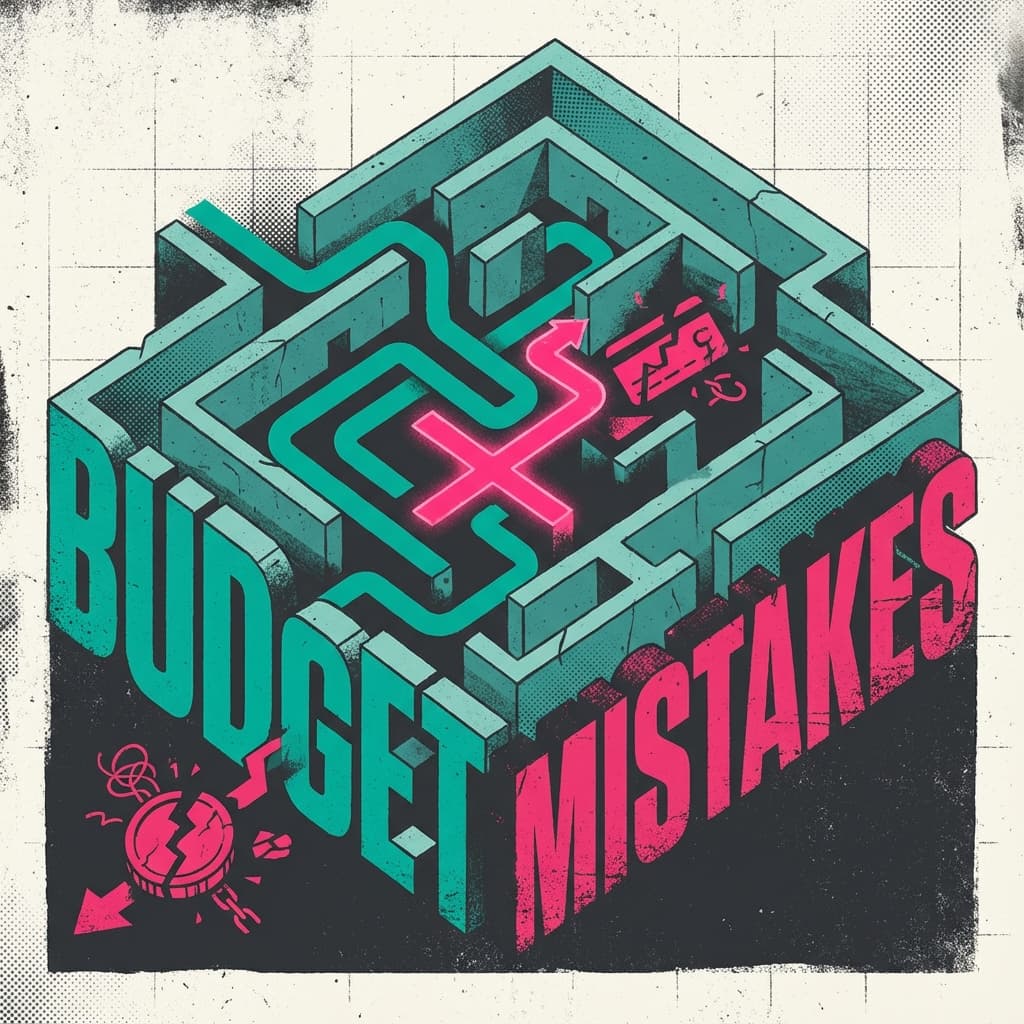
Budgets do not usually collapse because someone lacked discipline. They collapse because a number in them was wrong from the first day: pay counted before tax, an insurance renewal never divided by twelve, a grocery limit set by a stranger's template, or a partner who was never part of the plan.
Below are twelve mistakes, each with a test so you can tell whether it is yours, the arithmetic behind the fix, and the evidence where evidence exists — then a recovery sequence for the week after a blown month.
First, the scale of the problem
How common budget failure actually is
Self-reported survey findings, United States
Source: FINRA Investor Education Foundation, National Financial Capability Study (6th edition), 2024 wave, n=25,539; Consumer Financial Protection Bureau, Making Ends Meet in 2024, Fielded January 2024, n=4,486; Federal Reserve Board, Report on the Economic Well-Being of U.S. Households in 2025, Fielded 17-28 October 2025
Only 38% of US adults told the FINRA Investor Education Foundation they spend less than their income, down from 43% in 2021. Across the 39 countries in the OECD/INFE 2023 survey of 68,826 adults, only 63% said they keep track of their money in the short term. Whatever you are getting wrong, most people are getting it wrong too.
Mistake 1: You never worked out the gap
This is you if: you can name roughly what you earn but not what you spend, and have never subtracted the second from the first.
A budget is not a set of rules. It is one subtraction: net income minus committed outgoings. People skip it because they are afraid of the answer, then set category limits on top of a gap they have never measured.
The fix: export three months of statements, total every outgoing month by month, average them, and compare that to your take-home pay. If the answer is negative, category discipline will not help. If it is positive, that surplus is the entire budget you have to allocate. The step-by-step household budget guide walks through the export, and the budget calculator does the arithmetic.
Mistake 2: You budgeted on gross pay
This is you if: your budget's income line matches the salary in your contract or job ad.
The error is invisible, which is why it is so destructive. Budgeting a $70,000 salary as $5,833 a month overstates spendable income by federal and state tax, FICA, health premiums and any 401(k) contribution; budgeting £45,000 as £3,750 overstates it by income tax, National Insurance, pension and any student loan repayment. Either way the budget balances on paper and overdraws in reality.
The fix: the income line is the number that lands in your account, taken from the bank rather than the payslip's top line. If pay varies, take the lowest of your last six deposits and budget that floor, allocating anything above it only once it arrives — the core method in the irregular income guide.
Mistake 3: You forgot the bills that do not arrive monthly
This is you if: an annual renewal has wiped out a month for you at least once in the past year.
This is the most expensive mistake on the list, and it is pure arithmetic. Car insurance, holiday spending, servicing, annual subscriptions and birthdays are all predictable. They are simply not monthly, so a monthly-only budget never sees them coming.
Six ordinary annual bills, converted to a monthly sinking fund
Worked example for a US household with one car — divide each annual amount by 12
Source: US Bureau of Labor Statistics, Consumer Expenditure Surveys (Table A), Vehicle insurance line only: $1,993 per consumer unit, 2024
$4,813 a year is $401 a month a monthly-only budget has quietly ignored. Note how fast the biggest line moves: BLS data shows vehicle insurance rose 12.3% in 2024 after 11.5% the year before, so last year's figure is not this year's.
The fix: list every non-monthly bill with its real amount and month, divide the total by 12, and treat the result as a fixed outgoing leaving on payday. Swap in your own equivalents by market — a UK list usually runs car insurance, Christmas, MOT and service, travel insurance and a TV licence.
Edge case: if a bill lands in under twelve months, divide by the months you actually have. A $1,993 renewal five months away needs $399 a month, not $166.
Mistake 4: You set amounts your own history says are impossible
This is you if: you cut a category by more than about a quarter in one step, and blew through it in week two.
If you have spent $800 a month on groceries for a year, a $500 limit is not a budget, it is a wish. You will exceed it, feel like a failure, and abandon the whole system over one line.
People overshoot targets they set themselves. In a randomised trial with 9,035 participants run inside a fintech app, Irrational Labs and the Common Cents Lab found budgeting tools produced no significant reduction in spending against a control group ($675.97 control versus $681.08 for a single budget), and that budgeters overspent their own budgets by 1.3 to 1.4 times. It was not peer reviewed and ran 13 weeks, so treat it as a caution rather than a law.
Crash cut versus staged reduction on a grocery budget
Worked example: a US household starting at $800 a month. Read the values in your own currency.
- Crash limit set at $500
- Actual spend after the crash cut
- Actual spend, cutting ~10% a stage
Show the data
| Month | Crash limit set at $500 | Actual spend after the crash cut | Actual spend, cutting ~10% a stage |
|---|---|---|---|
| Month 1 | 500 | 780 | 720 |
| Month 2 | 500 | 760 | 700 |
| Month 3 | 500 | 800 | 690 |
| Month 4 | 500 | 815 | 660 |
| Month 5 | 500 | 790 | 655 |
| Month 6 | 500 | 820 | 640 |
The fix: set the first limit at your actual average, then cut roughly 10% per stage and hold each stage for two full months before the next cut. Three stages from $800 lands near $580 in six months, which the crash plan never reached.
Mistake 5: You budgeted zero fun money
This is you if: your budget contains no line you are allowed to spend without justifying it.
A budget with no personal allowance behaves like a crash diet: it works for a fortnight, then produces a compensating binge costing more than the allowance would have.
The fix: give every adult a fixed personal amount, no questions, no receipts. It can be small; what matters is that it is unaccountable. House guidance rather than a research finding: a budget you follow four weeks in five beats a perfect one you abandon in week three.
Mistake 6: You copied someone else's categories and never picked a method
This is you if: your categories came from a template and half of them are always empty.
Two errors hide here. The first is category fit: a template built for a car-owning suburban family is wrong for a renter with no car and a large pet bill. The second is that most people never choose a budgeting method, so they hold a list of numbers with no rule for what happens when one runs out.
The fix: build categories from your own three months of statements, using the full budget category list as a checklist rather than a template. Then commit to one method: zero-based budgeting if you want every unit of currency assigned, the envelope system if you overspend on variable categories, or the 50/30/20 rule for the lowest-maintenance version that still works.
Mistake 7: You trusted the automatic categorisation
This is you if: your app says "shopping" is your biggest category and you have never looked inside it.
Automatic categorisation is genuinely useful and genuinely wrong at the margins. A supermarket that also sells fuel and clothing lands under one heading, a payment processor's name appears instead of the merchant's, and a transfer between your own accounts registers as income. Budget on unreviewed categories and you will optimise the wrong line.
The fix: once a month, open your largest category and read the transactions rather than the total, recategorising anything obviously wrong before you draw conclusions. Ten minutes of this inside a weekly budget review prevents a month of misdirected effort.
Mistake 8: You tracked once and never again
This is you if: you built the budget, felt organised, and have not opened it since.
A budget never compared against actual spending is a document, not a system. Only 63% of adults across the 39 countries in the OECD/INFE survey keep track of their money in the short term, so roughly one in three does not track at all.
Be realistic about what tracking buys you. A UK randomised controlled trial published in the European Journal of Finance gave money-management apps to credit union members in Derry: the treatment group became more likely to track income and spending and more resilient to a financial shock, but their overall financial wellbeing did not improve within the six-month trial. Tracking is necessary, not sufficient, and not instant.
The fix: two minutes daily or fifteen minutes weekly, at a fixed time. Put it in the calendar; unscheduled review does not happen.
Mistake 9: You treated saving as whatever is left over
This is you if: your savings line is the last row of the budget rather than the first.
There is never anything left over, because spending expands to fill the available balance.
The Consumer Financial Protection Bureau's analysis of savings-app account data found guaranteed rules — save a set amount every payday — were associated with roughly a 1.5 to 3.5 times larger increase in the maximum saved within a year than spending-contingent rules such as round-ups. Yet round-ups were used by 81% of savings goals and payday rules by only 41%: the popular strategy was not the effective one. This is observational data from one app, so it shows association rather than cause.
The fix: an automatic transfer dated the day after payday, before the money is visible. This is the whole of pay yourself first, and the amount matters far less than the automation.
Mistake 10: You have no buffer, so every surprise becomes debt
This is you if: an unexpected bill of a few hundred goes on a credit card.
Without a buffer, every irregular expense converts into interest-bearing debt, and that interest becomes a new fixed cost that makes the next surprise harder to absorb.
The resilience figures are sobering in every market, though the questions differ so they are not strictly comparable. The Federal Reserve found 55% of US adults said they had set aside three months of expenses, while 12% said they could not pay a $400 emergency expense by any means. In Great Britain, the Office for National Statistics found one in four adults (25%) said their household could not pay an unexpected but necessary £850 expense in May 2026.
The fix: build one month of essential outgoings first, as a single achievable target, before attempting three to six. One month is the point at which a surprise stops being a debt event. How much emergency fund you need sizes it against your own outgoings rather than a generic multiple.
Mistake 11: You budgeted alone while the money was shared
This is you if: you know the household's numbers and your partner does not, or the reverse.
A solo budget in a shared household is a forecast of one person's behaviour, so it is wrong by construction. It also builds resentment both ways: one person feels controlled, the other feels solely responsible.
The evidence here is thinner than the advice usually implies. Among the 13% of UK adults the FCA's Financial Lives survey classes as finding bills and credit commitments a heavy burden, one in four said their debts had caused relationship problems — that base is the heavily burdened group, not all adults. A Legal & General poll of 3,000 UK adults in relationships in July 2025 found 18% often argue about money and 17% avoid the conversation altogether, though that is company-commissioned polling rather than official statistics.
The fix: one shared view of the numbers, personal allowances neither person has to explain, and a scheduled conversation rather than an argument-triggered one. Budgeting as a couple covers the mechanics, money date night the conversation, and how to split bills with a partner the arithmetic when incomes differ.
Mistake 12: You budgeted money that was not guaranteed
This is you if: a bonus, commission, overtime or tax refund is in your plan before it is in your account.
Variable pay budgeted as fixed pay produces a plan that works in good months and fails in ordinary ones. The mirror image is commitments: buy-now-pay-later instalments and annual subscriptions are obligations you already signed for, so they belong in the fixed list.
Forgotten recurring charges are a documented pattern. Asked for a quick estimate of monthly subscription spending, US consumers in a C+R Research survey said $86; itemising each subscription produced $219, more than 2.5 times higher. That is a commercial survey of 1,000 consumers with 2022 fieldwork, so treat the dollar levels as dated — the underestimation is the point. In the UK, the Department for Business and Trade estimates nearly 10 million of 155 million active subscriptions are unwanted, costing around £1.6 billion a year (a central estimate inside a £0.53bn to £3.89bn range), roughly £14 a month each.
The fix: budget the guaranteed floor and allocate windfalls only after they clear. Then run a subscription audit against your statement rather than your memory, and add every surviving instalment plan to the fixed list.
The seven-day reset after a blown month
Giving up after one bad month turns a fixable error into an abandoned system. Overspending is data. Here is the sequence.
What to do in the week after a month goes wrong
- Day 1: find the actual overspend, not the feelingTotal the month and subtract the budget. Usually one or two categories account for nearly all of it and the rest were fine.
- Day 2: classify itWas it a one-off (a repair, a funeral, a trip), a wrong number (this category always overruns), or a genuine slip? Only the third one is about behaviour.
- Day 3: rebalance from one named categoryMove the overspend out of a specific category this month rather than vaguely tightening everything. Naming the source is what stops it recurring.
- Day 4: fix the number if it was wrongIf a category has overrun three months running, raise it to its real average and cut elsewhere. Three overruns is evidence, not weakness.
- Day 5: check the calendar for the next 90 daysRenewals, birthdays, travel, school costs. Most repeat blow-ups are a sinking fund that was never created.
- Days 6-7: forgive the month and restart on scheduleDo not attempt to claw the overspend back in one month. Spread it, or absorb it, and keep the review appointment.
When budgeting is not the answer
If your income does not cover your essential costs, budgeting cannot close the gap. Among people who approached StepChange for debt advice in 2025, 28% were in a negative budget: monthly spending exceeded income even after the charity's own advice and budgeting process — down from 30% in 2024. That base is people already seeking debt help, not the general population, but the point holds — at that stage the work is income, benefits entitlement, creditor negotiation and free debt advice, not category limits. UK readers can start with the debt guide.
Budgeting tools have a modest evidence base. The 9,035-person trial found no significant spending reduction; the UK randomised trial found better tracking without better wellbeing inside six months. A budget makes money visible and controllable. It does not, by itself, make you richer.
Some mistakes are structural rather than personal. A rent increase, an insurance renewal jumping double digits, or a shift pattern that moves your income are not budgeting failures. Budget the floor, plan the renewals, and stop treating volatility as a character flaw.
Frequently asked questions
What is the most common budgeting mistake?
Forgetting expenses that do not arrive monthly. It guarantees a blown month even when every other number is right, because the money was never in the plan. The fix is arithmetic: total your annual and quarterly bills, divide by twelve, treat the result as a fixed monthly outgoing.
Why does my budget fail in the last week of every month?
Usually because the monthly total was too low from day one, not because discipline collapses at week four. Rebuild each category from your own last three months of statements, and check whether an irregular bill lands in that week. Both causes look identical from the inside.
How much should I set aside for irregular expenses?
Add up every non-monthly bill you can name for the coming year and divide by twelve. In the worked US example above, six ordinary bills came to $4,813 a year, or $401 a month. If a bill lands in fewer than twelve months, divide by the months you actually have.
How long before a budget starts working?
Expect the first two or three months to be measurement rather than improvement, because you are still finding your real numbers. The best causal evidence is deliberately modest: the UK randomised trial found better tracking and better resilience to a surprise bill within six months, but no measurable improvement in overall financial wellbeing in that window.
Where to go next
- The complete budgeting guide — the full system these fixes sit inside
- How to stick to a budget — the habits that keep one alive past week three
- Emergency fund calculator — size the buffer from your real outgoings
Put this into practice
iBudget turns the fixes above into something you actually track: your own categories, sinking funds for the bills that are not monthly, and a shared view if you budget with a partner.
Start budgeting free — free plan, no card required, no bank logins.
About iBudget
iBudget helps couples and families take control of their finances with simple, collaborative budgeting tools. Track spending, set goals, and build wealth together.
Start Your Budget